

A Net Of A Cube
Overview and Objective
In this activity, students volition explore different nets of a cube while also investigating border, face, and vertex backdrop of cubes.
Warm-Up
Get-go by inserting a cube into a bare canvas from the 3D solids collection of Polypad. Click here to larn more about using the nets. Talk well-nigh the number of square faces, edges, and vertices. You can use the points and lines to highlight the edges and vertices of the cube. Adjusting the transparency of the cube helps students to see these details improve.
Use the unfold option to show the net of the cube. Talk virtually this T-shape organisation of 6 squares as just i of the possible nets that tin can exist folded up to a cube.
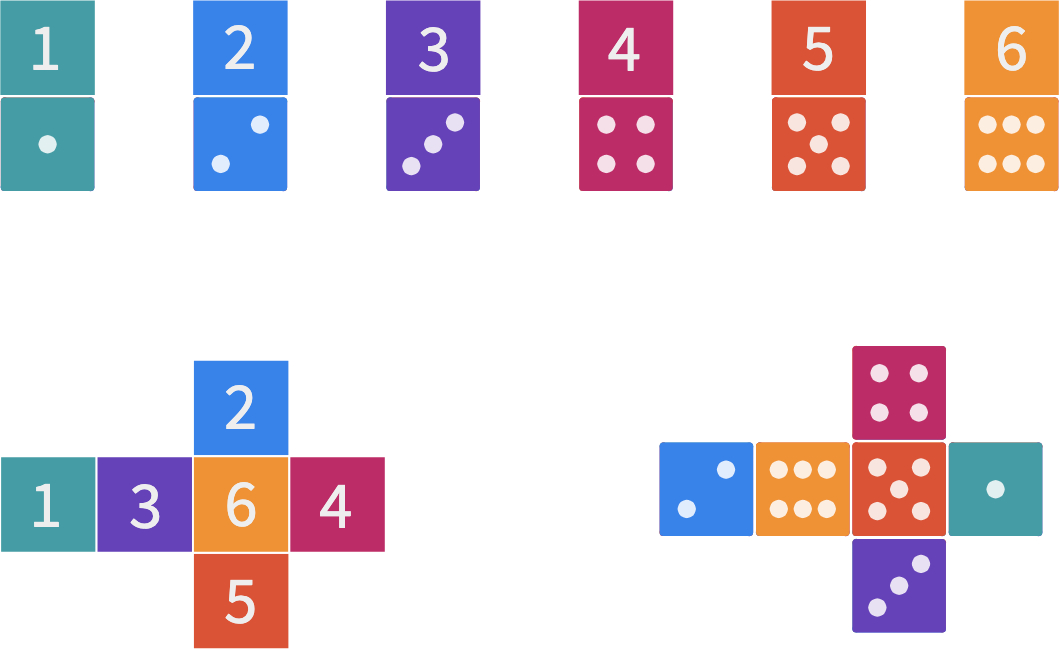
Perhaps the nigh well-known cubes used every day are dice. Roll a standard die using the Polypad die tool and inquire about the top and the lesser faces of the die. Students explore that the contrary sides of a standard die must add up to 7. Use this canvas to enquire the students to create the internet of a standard die using colored squares.
Primary Activity
A cube has six foursquare faces. Ask students if they remember that ways that any set of 6 squares tin fold upwards a cube? I of the most well-known nets of a cube is the T shape used in the warm-up to build a fair die. What other fix of 6 squares can fold upward a cube?
Start by showing a rectangular arrangement of squares and discuss as a class if it is possible to fold information technology. If the students already knew about tiling and tessellation, you may want to talk over the sum of angles at each vertex is 360 degrees, therefore this arrangement covers a plane without gaps and overlaps, and therefore folding is not possible.

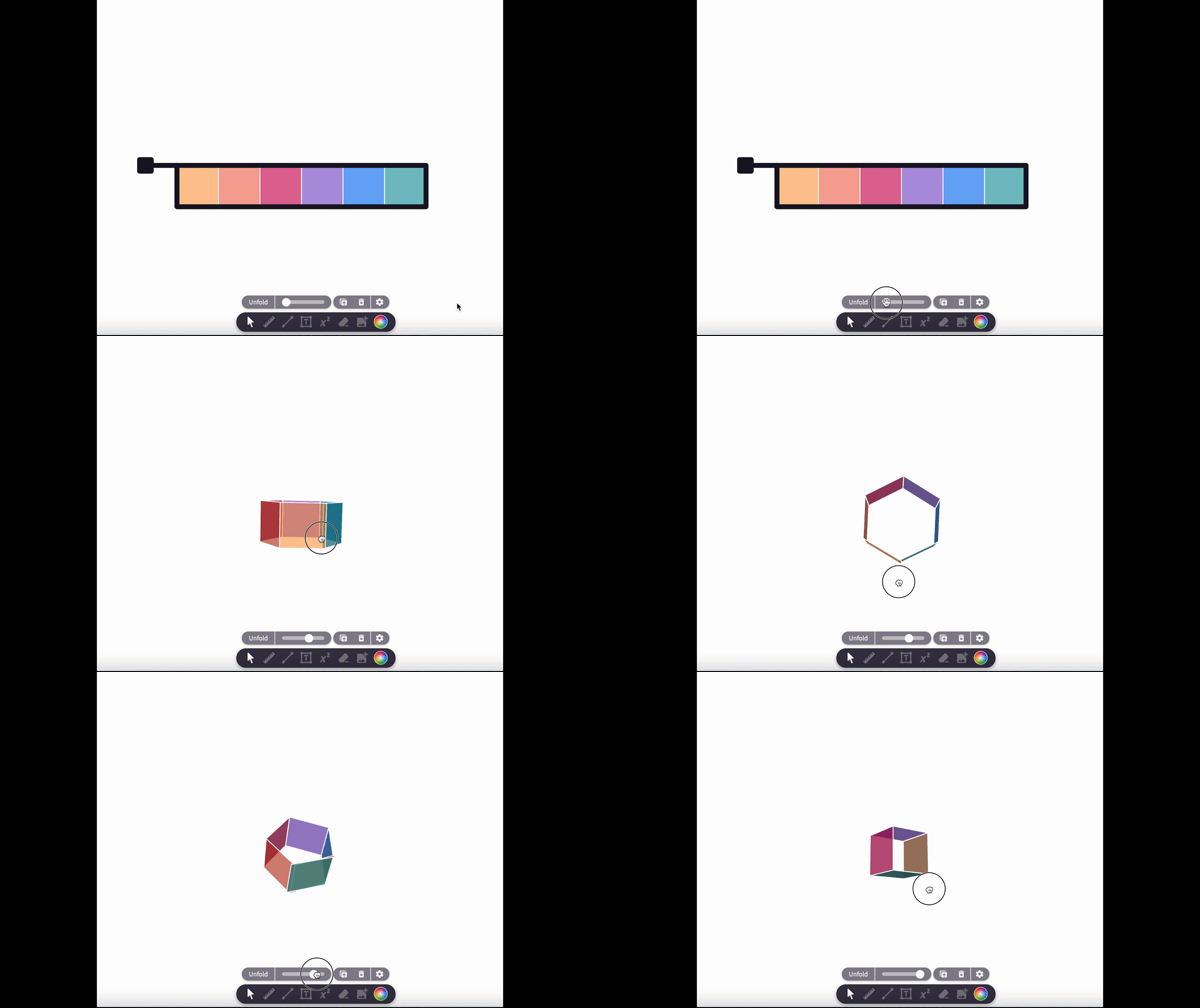
Show 1 x half-dozen rectangular arrangement of the squares. You lot may use dissimilar colors for the square faces to bear witness how some of the faces coincide when folding them up.
At this betoken, you lot may want to ask students the number of faces that meet at each vertex of the cube. They can also compare the T-shape net with ii counterexamples to conclude three squares demand to meet at a vertex when you fold the net of a cube.
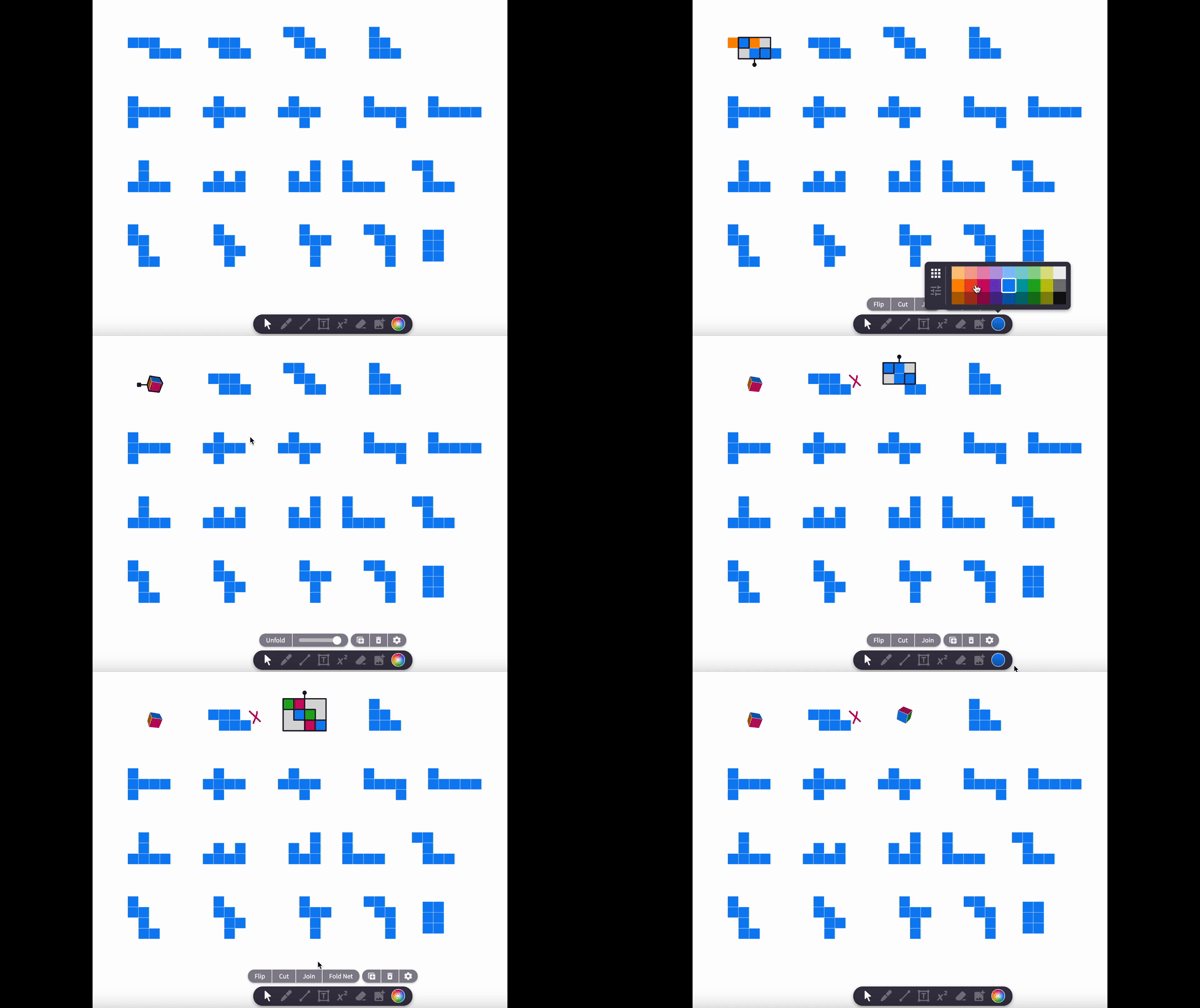
Place the students in pairs or groups of three and share this canvas and allow them work on which ane of these sets fold up to a cube. Alternatively, consider just asking each group to find all possible arrangements of 6 cubes that can make a internet. If you select this approach, you don't demand to share a starting canvas with them.
Ask students to color the reverse faces of the cube the same colour. Afterwards some piece of work time, share some student piece of work with the class. Utilise the folding the internet option to bank check the coloring.
Closure
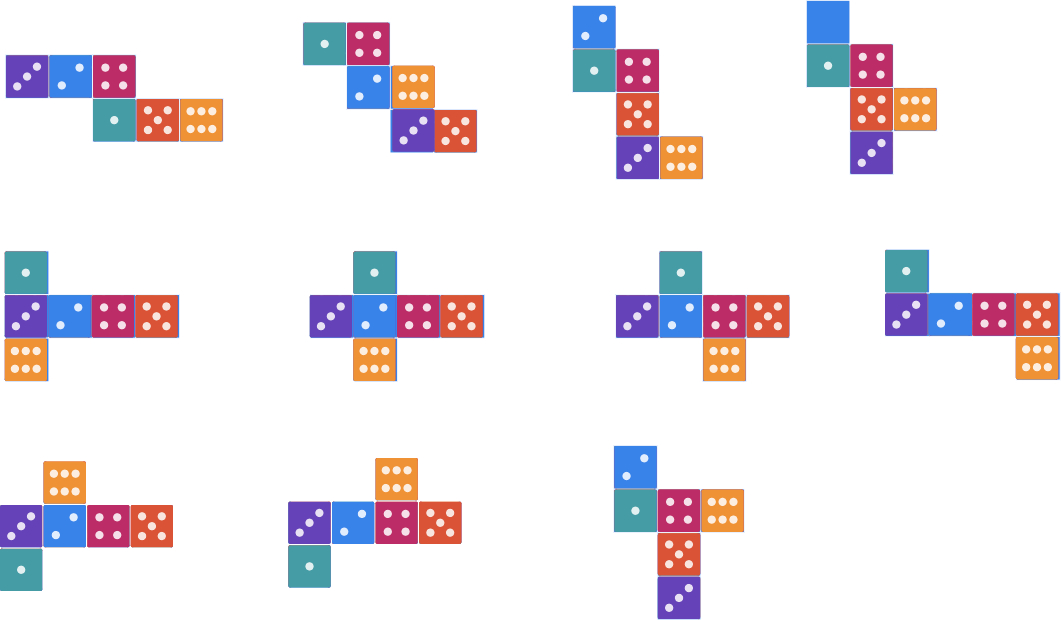
At the end of the lesson, assign each group a dissimilar net to pattern a standard die. Share some student work with the class. Some possible answers here are;
Yous may besides end the lesson with a mini-puzzle using this canvas.
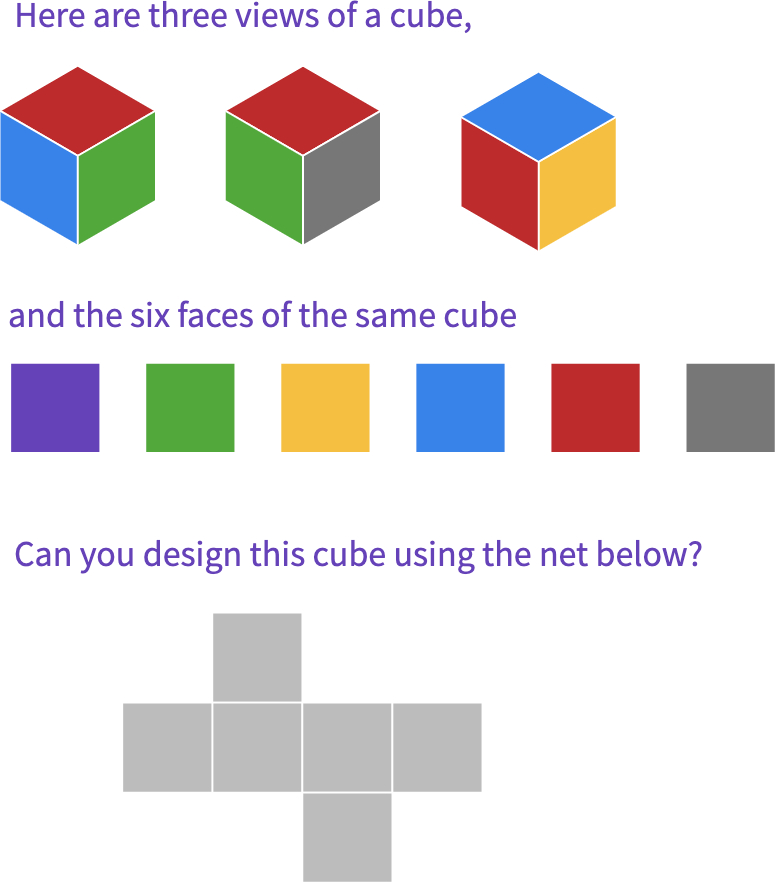
Here is a possible reply.

Support and Extension
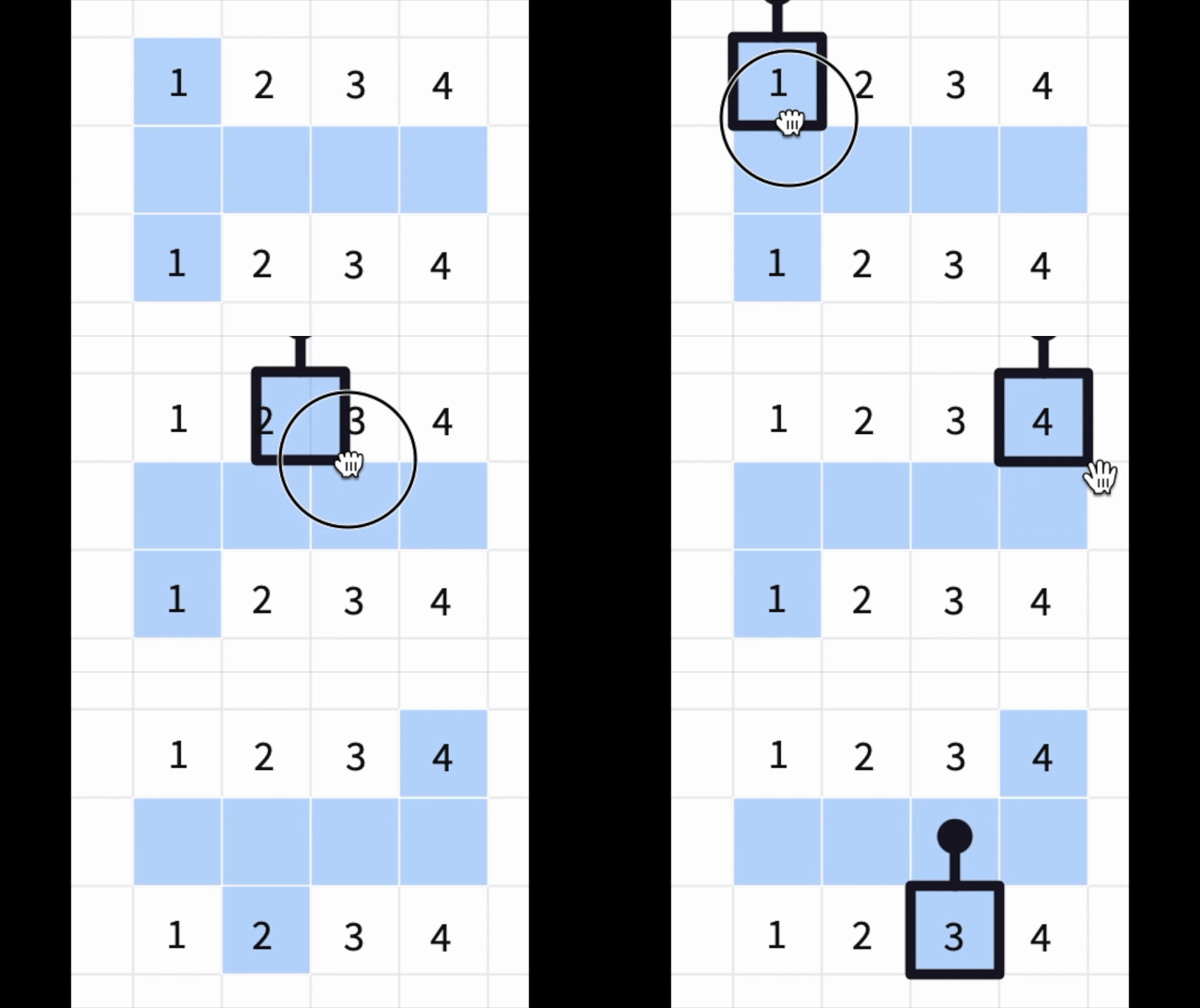
For students needing boosted support, the fold-upwardly option can be used before coloring the opposite faces for some particular nets. For instance, when i t-shape example is shown, students can alter the orientation of the caps to create 5 more nets.
Every bit an extension, consider request the possible nets of a tetrahedron, and a foursquare pyramid.
Polypad for This Lesson
To assign these to your classes in Mathigon, salve a copy to your Mathigon account. Click hither to learn about saving a Polypad into your business relationship and sharing it with your students.
Cubes Warm upwards – Polypad
http://polypad.org/Avr6Sd3OinGFGg
Nets – Polypad
http://polypad.org/XgEDbT9GrKMIKQ
Cube Puzzles – Polypad
http://polypad.org/67A3eOmbu1j9Q

A Net Of A Cube,
Source: https://mathigon.org/task/nets-of-a-cube
Posted by: potterrapen1954.blogspot.com
0 Response to "A Net Of A Cube"
Post a Comment